Cyclospora Infection Causing “Explosive Diarrhea” Is On The Rise In U.S.

on • Updated

A diarrhea-causing parasite is spreading through the United States, and a new outbreak was identified by the FDA on Thursday, July 23.
The Centers for Disease Control (CDC) first identified that an outbreak had occurred, with the start of July seeing higher-than-normal reporting of cyclosporiasis in the United States.
Federal and state investigators honed in on the popular fast food restaurant chain Taco Bell on July 16, having identified the farm that provides it produce, Taylor Farms, as being the source of the first known outbreak.
The Taylor Farms outbreak was initially noted to have impacted five states, but was expanded to nine states by the CDC on Friday, July 24. Indiana, Kentucky, Michigan, Ohio, and West Virginia were identified first; and Illinois, Kansas, Oklahoma, and Pennsylvania were identified by the CDC as part of the same outbreak on July 24.
Reports of a “false positive” briefly confused matters with Taylor Farms, but the FDA continues to hold that Taylor Farms is the source of that particular outbreak.
However, a new outbreak of cyclosporiasis was identified on July 23. Speaking with CBS News, the U.S. Food and Drug Administration (FDA) said that the second outbreak was identified through a traceback investigation.
Presently, the FDA says it has “not yet identified” the source of the latest outbreak.
This comes just a matter of days after HHS Sec. Robert F. Kennedy Jr. said on July 21 that the spread of cyclosporiasis is “under control.”
As of July 24, reports indicate the number of cases brought to the attention of state health departments is around 11,500, with approximately 41 states reporting cases.
The state of Michigan alone has over 8,100 reported cases, with the CDC’s reported case numbers being dramatically out of date.
To put the spread of cyclosporiasis in perspective, back on July 8, there were only 18 states reporting cases, compared to the 41 that have reported cases now.
RELATED: Tulsi Gabbard Declassifies Files Exposing COVID Cover-Up As Her Final Act As DNI
What Is Cyclosporiasis, And What Are Its Symptoms?
First identified from 1993 to 1994, cyclosporiasis was determined to be caused by a “human gastrointestinal pathogen” derived from the cyclospora cayetanensis parasite, the U.S. Department of Agriculture reported in 2023.
Cyclospora are believed to be spread “through human fecal pollution carried by agricultural water,” with the USDA’s report noting that cyclosporiasis “is characterized by symptoms such as explosive diarrhea, vomiting, fatigue, and weight loss.”
The report goes on to state:
“From a total of 70 outbreaks reported globally, 55 were caused by fresh produce. The fruits and vegetables most frequently related to Cyclospora infections were: raspberries (34%), basil (31%), cilantro (10%) and salad mixes (10%). Sugar snap peas, lettuce, blueberries, blackberries, carrots, mangos, mint, scallions, mixed vegetable trays, and fruit salads were also associated with cyclosporiasis outbreaks.”
The CDC created this helpful graphic for understanding the spread of cyclosporiasis:
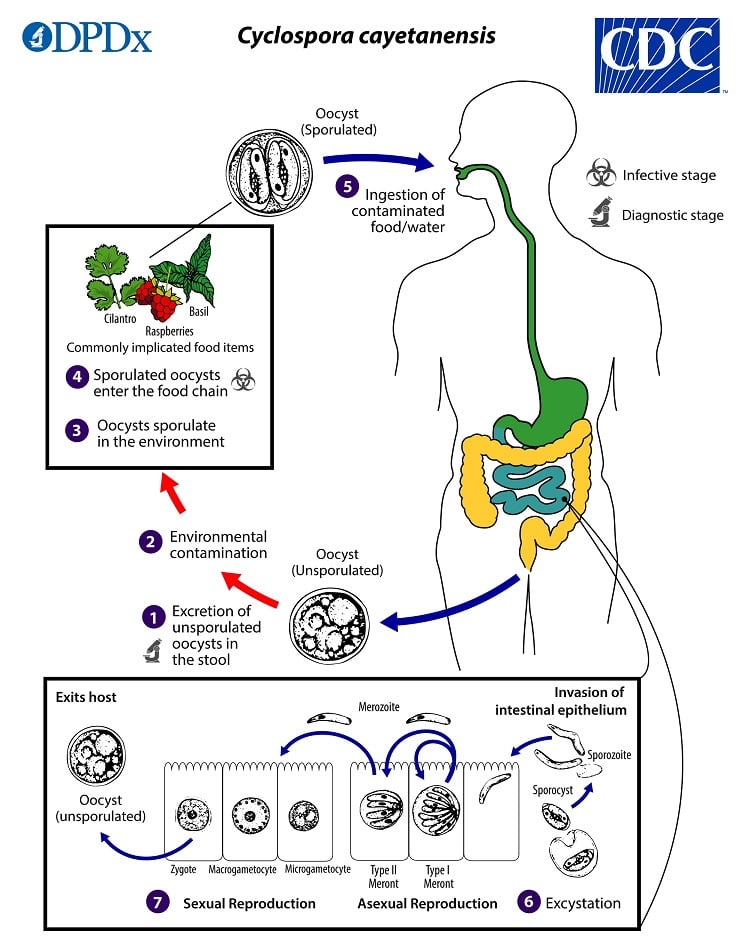
The CDC notes that humans appear to be the only viable host for the spread of cyclospora.
RELATED: RFK Jr. Announces Ban On Artificial Food Dyes Nationwide
Taylor Farms Remains Under Investigation In Spread Of Cyclosporiasis Through Taco Bell
From May 1 to June 16, the Centers for Disease Control (CDC) said 17 states had issued reports of “145 cases of cyclosporiasis acquired in the United States.”
Up until July 14, that number was not updated by the CDC, with reporting of infections at local and state health departments far surpassing the CDC’s statistics.
The CDC reported that cyclosporiasis season runs from May 1 to August 31.
In its July 14 report, the CDC had only confirmed 1,645 domestic cases of cyclosporiasis, but that number has increased to 4,173 as of the CDC’s update on July 21.
The CDC goes on to report that it “is aware of more than 7,400 cases that are not yet laboratory confirmed and require further investigation and analysis.”
Back on June 16, the CDC said, “There is currently no evidence of a single, multistate Cyclospora outbreak linking all cases,” but added that “local, state, and federal (CDC, FDA) public health authorities are investigating several clusters of cases in more than one state.”
Now, as of July 21, the CDC says:
“CDC is investigating multiple clusters of Cyclospora cases, including one multistate outbreak affecting 5 states linked to iceberg lettuce.”
In a July 16 report by The Detroit News, the Michigan Department of Health and Human Services alone reports that it’s had 4,312 cases in the state, with approximately 8,176 reported in Michigan by July 24.
Natasha Bagdasarian, of the Michigan Department of Health, told the Associated Press that “early information has shown lettuce as a common product that regularly comes up during the investigation.”
According to the Washington Post, state and federal officials determined some Taco Bell locations were a possible part of the cyclospora spread.
This was confirmed, according to Reuters on July 16, as iceberg lettuce sourced from the Mexico-based Taylor Farms supplies produce to five states where the outbreak has been predominantly reported: Indiana, Kentucky, Michigan, Ohio, and West Virginia.
Since then, on July 24, the five-state outbreak was expanded by the CDC into a nine-state outbreak, adding Illinois, Kansas, Oklahoma, and Pennsylvania, The New York Times reported.
Locally, some Taco Bell restaurants in Michigan have posted signs stating that they are “currently unable to sell Lettuce, Cilantro Onion, Pico de Gallo, and Guacamole due to a nationwide recall,” the Independent reports.
In a statement given to the Independent, a spokesperson for Taco Bell said:
“The health and safety of our guests is our top priority. Public health officials have not confirmed a link to Taco Bell or any specific ingredient, supplier, restaurant or retailer. While authorities continue their broader review, Taco Bell has voluntarily and temporarily removed limited ingredients at select restaurants as a precautionary measure. We will continue to closely monitor the situation and follow the guidance of public health authorities.”
Since Taco Bell’s statement, the FDA announced that Taylor Farms was identified as the source of the cyclospora outbreak in nine states, with Indiana, Kentucky, Michigan, Ohio, and West Virginia being identified first; and Illinois, Kansas, Oklahoma, and Pennsylvania being identified by the CDC as part of the same outbreak on July 24.
However, the FDA released on July 19 a somewhat confusing report about a “false positive” regarding Taylor Farms.
Responding to the initial finding, Taylor Farms de Mexico recalled its iceberg salads and lettuce.
When word of a “false positive” circulated, Taylor Farms made the finding widely known, but the FDA clarified that Taylor Farms is still implicated as the source of the major five-state outbreak.
See the FDA’s clarification about the Taylor Farms “false positive,” here:
To clarify, this false-positive lab sample DOES NOT change the basis for FDA’s ongoing outbreak investigation or the overwhelming epidemiological data supporting the current voluntary recall by Taylor Farms.
— U.S. FDA (@US_FDA) July 20, 2026
Over the weekend, FDA alerted Taylor Farms that a new sample of… https://t.co/hedRwhPLd8
Reported Cases Of Infections
As of July 24, the Detroit Free Press reported that Michigan says it has 8,176 reported cases of cyclosporiasis.
USA Today said that New York has 421 cases of cyclospora, with 301 of those cases coming from New York City. NBC News has that figure at 394.
Most of Ohio’s 177 cases of cyclospora have occured since June 20, USA Today noted.
The health department of North Carolina reportedly has observed 205 cases as of July 10, according to NBC News.
Illinois has also reported higher than usual cases of cyclospora, with 141 reported cases, the Illinois Department of Public Health told USA Today. NBC News has this figure at 117.
Several cases across many states have led to hospitalization.
It remains unclear which region of the United States is being impacted by the new outbreak identified by the FDA on July 23, but it remains under investigation.
The CDC’s map, reflecting its July 21 numbers, can be seen here:
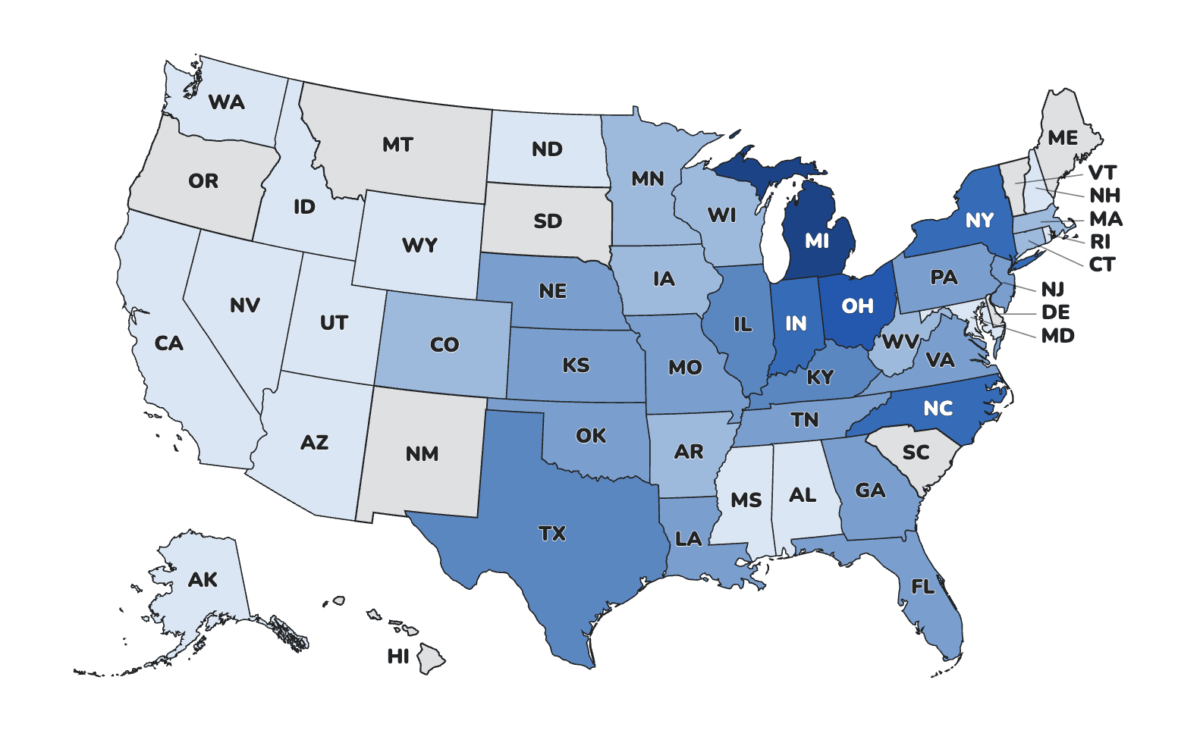
The following states report cases of cyclosporiasis (figures, in some cases, have been updated to reflect local data, courtesy of Fox 2 Now and CBS News):
- Alabama (1-10);
- Alaska (1-10);
- Arizona (1-10);
- Arkansas (11-30);
- California (1-10);
- Colorado (11-30);
- Connecticut (11-30);
- Florida (31-80);
- Georgia (31-80);
- Idaho (1-10);
- Illinois (81-160);
- Indiana (161-300);
- Iowa (11-30);
- Kansas (31-80);
- Kentucky (81-160)
- Louisiana (31-80);
- Maryland (1-10);
- Massachusetts (11-30)
- Michigan (8,176, as of July 24);
- Minnesota (11-30);
- Mississippi (1-10);
- Missouri (216, as of July 20);
- Nebraska (31-80);
- Nevada (1-10);
- New Hampshire (1-10);
- New Jersey (31-80);
- New York (161-300);
- North Carolina (161-300);
- North Dakota (1-10);
- Ohio (301-500);
- Oklahoma (31-80);
- Pennsylvania (31-80);
- Rhode Island (1-10);
- Tennessee (31-80);
- Texas (81-160);
- Utah (1-10);
- Virginia (31-80);
- Washington (1-10);
- West Virginia (11-30);
- Wisconsin (11-30);
- Wyoming (1-10).
To see the CDC’s latest map, only reflecting confirmed cases from its own investigation, visit the CDC website, here.
This is a developing story.
RELATED: FDA Admits Major Error In Cyclospora Outbreak Investigation… But It May Still Be Right