Daylight Saving Time Is Coming: Will We Still “Fall Back” In 2026?

on
Every year, most Americans change their clocks twice a year. Once in the spring, “springing forward” for Daylight Saving Time, and once in the fall, to “fall back” to Standard Time.
For the past couple years, folks have been keeping tabs on the Sunshine Protection Act.
What Is The Sunshine Protection Act?
The Sunshine Protection Act is a federal proposal that would make daylight saving time permanent across the United States, meaning Americans would no longer change their clocks twice a year.
The legislation would repeal the provision of the Uniform Time Act that establishes the seasonal switch between standard time and daylight saving time.
A version of the bill was reintroduced in 2025 as S. 29 in the Senate and H.R. 139 in the House; both were referred to congressional committees rather than becoming law.
On July 14, the United States House of Representatives voted 308-117 to approve allowing for an end to the practice of switching from Standard to Daylight Saving Time. This would give us more daylight in the evenings throughout the year.
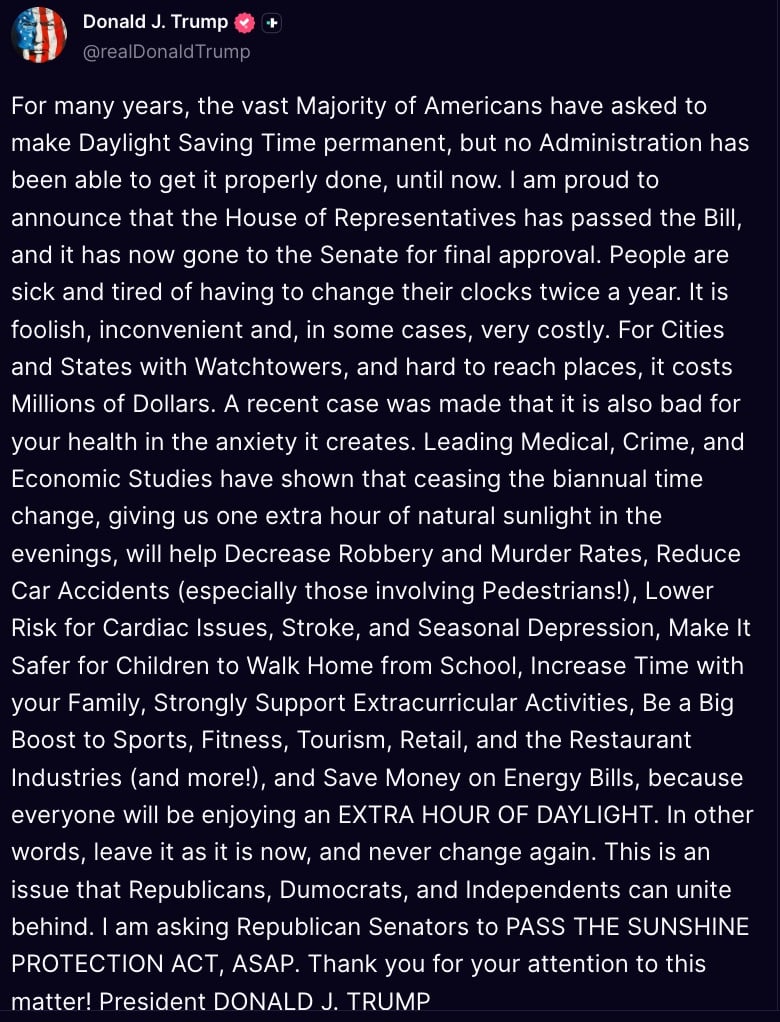
This garnered support from President Trump, who said, “People are sick and tired of having to change their clocks twice a year. It is foolish, inconvenient and, in some cases, very costly. For Cities and States with Watchtowers, and hard to reach places, it costs Millions of Dollars.”
Under the proposed law, states that already observe permanent standard time, including Hawaii and most of Arizona, would be exempt from the change. Meanwhile, 19 states have passed legislation supporting permanent daylight saving time, but those measures would still require approval from Congress to take effect.
In August, President Trump seemed confident the Senate would pass the bill.
What Is The Downside To Permanent Daylight Saving Time?
According to Fox 29, “Some sleep specialists and medical professionals argue that if we are going to stop changing the clocks, we should adopt permanent standard time, not permanent daylight saving time.”
They argue that in the winter months, Americans, especially children and teens will have to wake up and commute to school in the darkness.
Dr. Jennifer L. Martin, a spokesperson for the American Association of Sleep Medicine, stated in a recent report, “The scientific evidence consistently shows that permanent standard time better aligns with our natural circadian rhythms, supports healthier sleep, and promotes improved daytime functioning.”
Will Our Clocks “Fall Back” In 2026?
With the fall approaching fast, many have one question: will we be falling back this year?
Our answer at this moment is: we don’t know yet!
After the House passed the Sunshine Protection Act in July, it has to be voted on by the Senate Commerce, Science, and Transportation Committee. It has not been up for a vote yet. With the Senate returning from recess on September 14th, many are hopeful they will put it to a vote sooner rather than later.
In order for the Sunshine Protection Act to become a bill, the Senate must pass it and President Trump must sign it into effect by November 1, 2026. If it does not pass, we will still change our clocks on November 1st.
Until then, we just wait. What are your thoughts on Daylight Saving Time?