First Deaths Reported In Ongoing Cyclospora Outbreak

on • Updated

In June, a few cases of a parasitic infection known by the U.S. Department of Agriculture (USDA) to cause “explosive diarrhea” were reported.
Now, there are over 15,000 confirmed cases, with two people who have died with cyclosporiasis.
Numbers of reported infections from the cyclospora parasite have increased, with one reported outbreak of cyclospriasis affecting people in 17 states.
That particular outbreak was identified on July 17 by the U.S. Centers for Disease Control (CDC) and the U.S. Food and Drug Administration (FDA) as having originated from iceberg lettuce shipped to some Taco Bell locations and Walmart from Taylor Farms.
The outbreak sourced from Taylor Farms was initially thought to be a five-state outbreak, but the FDA’s investigation led to the count increasing to a total of 15 states on Aug. 5.
As of Aug. 13, the FDA has added two more states to the Taylor Farms outbreak, adding Maine and Massachusetts, for a total of 17 states.
The FDA said, “This increase in cases is due, in part, to the inclusion of people who reported exposure to Taco Bell or recalled Taylor Farms de Mexico iceberg lettuce and the identification and addition of six new states that are now linked to this outbreak.”
Despite the recalled Taylor Farms lettuce, the FDA went on to note that it expects to see the number of cases continue to rise as it can take six weeks for state and health officials to determine one’s connection to a specific outbreak.
In its Aug. 13 update, the FDA stated that it is “confident that all recalled iceberg lettuce related to this specific Cyclospora outbreak is off the market.”
The 17 states impacted by the Taylor Farms outbreak are, as follows:
- Arkansas;
- Iowa;
- Illinois;
- Indiana;
- Kansas;
- Kentucky;
- Maine
- Massachussets;
- Michigan;
- Missouri;
- Nebraska;
- New Hampshire;
- North Carolina;
- Ohio;
- Oklahoma;
- Pennsylvania; and
- West Virginia.
Asked about the outbreak, HHS Sec. Robert F. Kennedy Jr. said on July 21 that the spread of cyclosporiasis is “under control.”
As of Aug. 18, there are 47 states — as well as Washington, D.C., and Puerto Rico — that are reporting cyclospora-related illnesses, with the CDC stating there are at least 15,716 confirmed cases nationwide.
Further, the CDC reports there are “more than 10,455 additional cases of cyclosporiasis that are not laboratory confirmed or require further investigation.”
Meanwhile, the state of Michigan says it has 13,909 reported cases all on its own, as of Aug. 13.
RELATED: Dr. Fauci Pleads The 5th At Congressional Hearing On Alleged COVID-19 Origins Cover-Up
First Deaths From Cyclospora Infection Reported
The state that has been most significantly impacted by the cyclospora outbreak has been Michigan, which has reported more than 13,000 cases of the parasitic infection.
On Aug. 3, the first two deaths from the 2026 cyclospora outbreak were reported by the Michigan Department of Health and Human Services (MDHHS).
In a news release, MDHHS said:
“Two deaths have been identified as part of the cyclosporiasis outbreak affecting Michigan. According to medical records, both individuals had significant underlying health conditions that may have been impacted by cyclosporiasis and dehydration. No additional information will be provided on these two cases.”
The identities of the deceased were not released.
The MDHHS goes on to note, “Cyclosporiasis is generally not a life-threatening illness. Death resulting from cyclosporiasis is uncommon in the United States.”
Typically, the cyclosporiasis season goes from May 1 through Aug. 31, according to the CDC.
First identified from 1993 to 1994, cyclosporiasis was determined to be caused by a “human gastrointestinal pathogen” derived from the cyclospora cayetanensis parasite, the USDA reported in 2023.
Cyclospora are believed to be spread “through human fecal pollution carried by agricultural water,” with the USDA’s report noting that cyclosporiasis “is characterized by symptoms such as explosive diarrhea, vomiting, fatigue, and weight loss.”
The report goes on to state:
“From a total of 70 outbreaks reported globally, 55 were caused by fresh produce. The fruits and vegetables most frequently related to Cyclospora infections were: raspberries (34%), basil (31%), cilantro (10%) and salad mixes (10%). Sugar snap peas, lettuce, blueberries, blackberries, carrots, mangos, mint, scallions, mixed vegetable trays, and fruit salads were also associated with cyclosporiasis outbreaks.”
Humans are believed to be the only viable host for the spread of cyclospora.
Reported Cases Of Infections
As of Aug. 13, CBS News reports that Michigan says it has 13,909 reported cases of cyclosporiasis.
USA Today said that New York has 421 cases of cyclospora, with 301 of those cases coming from New York City. NBC News has that figure at 394.
Most of Ohio’s 177 cases of cyclospora have occurred since June 20, USA Today noted.
The health department of North Carolina reportedly has observed 205 cases as of July 10, according to NBC News.
Illinois has also reported higher than usual cases of cyclospora, with 141 reported cases, the Illinois Department of Public Health told USA Today. NBC News has this figure at 117.
Several cases across many states have led to hospitalization, with the CDC reporting there have been 423 hospitalizations nationwide as of July 27.
It remains unclear which region of the United States is being impacted by the new outbreak identified by the FDA on July 23, but it remains under investigation.
Per the Taylor Farms 17-state outbreak sourced from iceberg lettuce sold at some Taco Bell and Walmart locations, the FDA said on Aug. 5 when it was still a 15-state outbreak:
“The true number of sick people in this multistate outbreak is likely higher than the number reported, and the outbreak may not be limited to the states with known illnesses. This is because some people recover without medical care and are not tested for Cyclospora. In addition, recent illnesses may not yet be reported because it can take as long as 6 weeks to determine if a sick person is part of a Cyclospora outbreak.”
The CDC’s map, reflecting its Aug. 18 numbers, can be seen here:
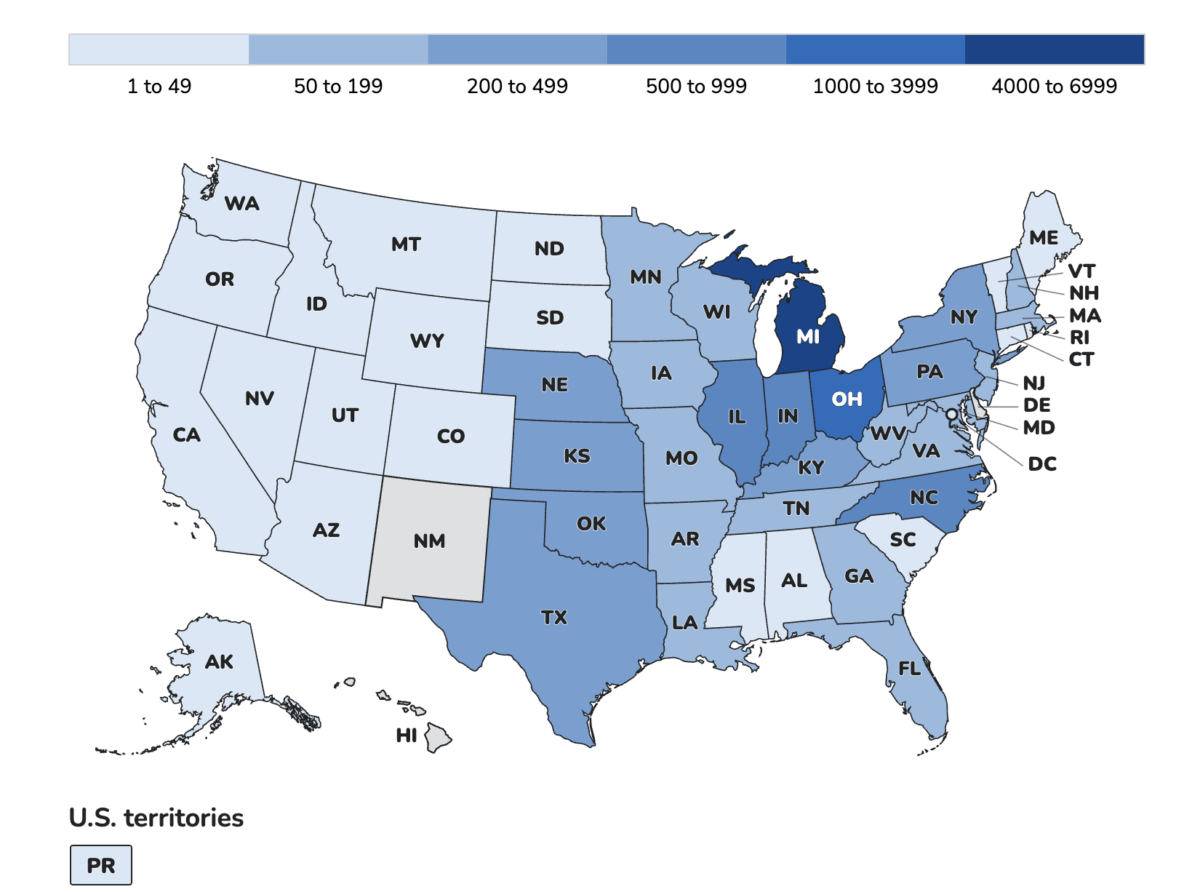
Notably, the CDC’s numbers have been consistently lower than numbers reported by individual state health departments. Further, the CDC and FDA have both been slow to update their numbers.
CNN notes that the figure is at least around 18,000, using the CDC’s numbers on confirmed and suspected cases.
Using the CDC’s numbers, these are the numbers of confirmed cases of cyclosporiasis:
- Alabama (1 to 49);
- Alaska (1 to 49);
- Arizona (1 to 49);
- Arkansas (50 to 199);
- California (1 to 49);
- Colorado (1 to 49);
- Connecticut (1 to 49);
- Delaware (1 to 49);
- District of Columbia (1 to 49);
- Florida (50 to 199);
- Georgia (50 to 199);
- Idaho (1 to 49);
- Illinois (500 to 999);
- Indiana (500 to 999);
- Iowa (50 to 199);
- Kansas (200 to 499);
- Kentucky (200 to 499);
- Louisiana (50 to 199);
- Maine (1 to 49)
- Maryland (50 to 199);
- Massachusetts (50 to 199);
- Michigan (4,000 to 6,999, with local reporting exceeding 13,909);
- Minnesota (1 to 49);
- Mississippi (1 to 49);
- Missouri (50 to 199);
- Nebraska (50 to 199);
- Nevada (1 to 49);
- New Hampshire (50 to 199);
- New Jersey (50 to 199);
- New York (200 to 499);
- North Carolina (500 to 999);
- North Dakota (1 to 49);
- Ohio (1,000 to 3,999);
- Oklahoma (200 to 499);
- Oregon (1 to 49);
- Pennsylvania (50 to 199);
- Puerto Rico (1 to 49);
- Rhode Island (1 to 49);
- South Dakota (1 to 49);
- Tennessee (50 to 199);
- Texas (200 to 499);
- Utah (1 to 49);
- Vermont (1 to 49);
- Virginia (50 to 199);
- Washington (1 to 49);
- West Virginia (50 to 199);
- Wisconsin (50 to 199); and
- Wyoming (1 to 49).
To see the CDC’s latest map, only reflecting confirmed cases from its own investigation, visit the CDC website, here.
This is a developing story.
RELATED: FDA Admits Major Error In Cyclospora Outbreak Investigation… But It May Still Be Right