Trump Signs Initial Peace Deal With Iran

on • Updated
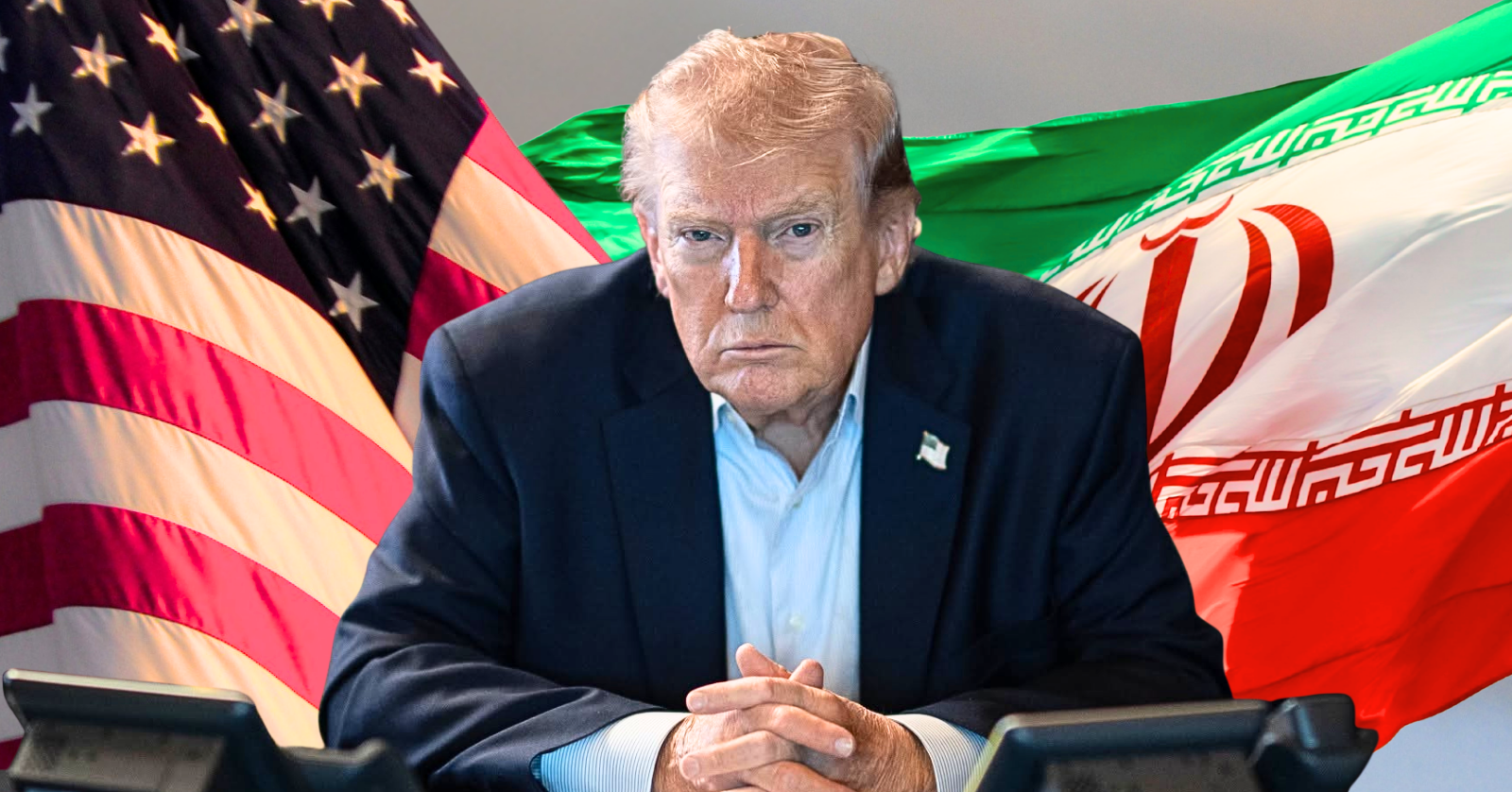
After 106 days of Operation Epic Fury, which saw the United States military engage in military action against the Islamic Republic of Iran, President Donald Trump announced in the afternoon of Sunday, June 14, that a deal had been reached.
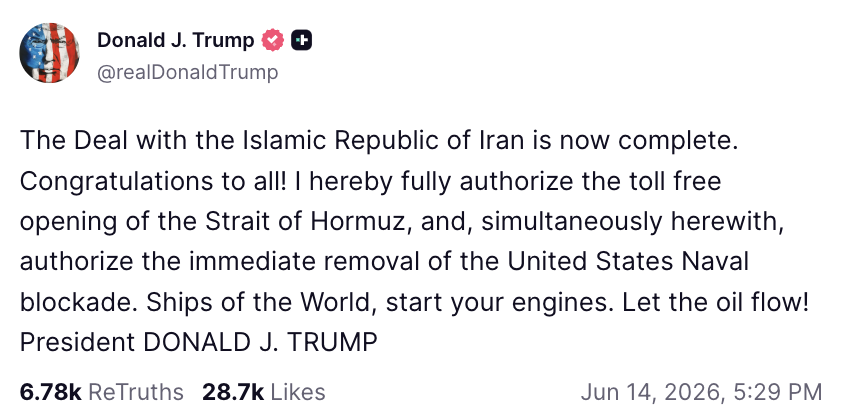
“The Deal with the Islamic Republic of Iran is now complete,” Trump wrote on Truth Social. “Congratulations to all!”
With this announcement, Trump also shared that the Strait of Hormuz is officially open, saying, “Ships of the World, start your engines. Let the oil flow!”
However, in the days that have passed leading up to what was supposed to see a formal June 19 signing of the deal in Switzerland, many rumors about the deal have been circulating.
While giving a press conference at the G7 Summit on Wednesday, June 17, Trump had a White House official read the 14 points of the deal aloud for members for the press.
Of the deal, Trump said, “On Sunday, we reached an agreement with Iran that achieves everything we set out to accomplish — everything, and much more.”
Later that day, on June 17, Trump surprised many by signing the Memorandum of Understanding (or MOU) between the United States and Iran at a dinner at Versailles.
🚨 President Donald J. Trump has SIGNED the Iran Memorandum of Understanding at Versailles in France. 🇺🇸 pic.twitter.com/JQ6qlbvFAF
— The White House (@WhiteHouse) June 17, 2026
Now, a 60-day period has begun leading up to the finalization of the deal.
With the signing of the MOU, gas costs are expected to go down in the coming days and weeks.
According to AAA, the national gas average on June 17 were $4.0250. Already, on June 18, the average cost of gas has dropped to $3.9990.
Regardless, the terms of the MOU, as outlined below, have drawn mixed reactions from members of Congress, including several prominent Republicans who have largely taken issue with a $300 billion rebuilding effort for Iran.
Sen. Bill Cassidy, R-LA, who wrote on X, formerly Twitter, “Reagan is rolling over in his grave. Iran’s nuclear ambitions were not curbed, and they have learned that threatening the Strait of Hormuz works and will undoubtedly leverage it in the future. Now, Iran gets to build brand-new infrastructure under this deal.”
See his full remarks, here:
Reagan is rolling over in his grave. Iran’s nuclear ambitions were not curbed, and they have learned that threatening the Strait of Hormuz works and will undoubtedly leverage it in the future. Now, Iran gets to build brand-new infrastructure under this deal.
— U.S. Senator Bill Cassidy, M.D. (@SenBillCassidy) June 17, 2026
Before the war, the…
Sen. Ted Cruz, R-TX, wrote on X, “I do want to urge the president not to give up the victory; we have destroyed their military, and we should not fund the rebuild.”
RELATED: Trump Reverses Order To Strike Iran “VERY HARD” As Peace Negotiations Advance
What’s In The 14-Point Deal With Iran?
Operation Epic Fury began on Feb. 28, with President Trump making the goal of the conflict, and its potential cost in the loss of American lives, clear.
“We pray for every service member as they selflessly risk their lives to ensure that Americans and their children will never be threatened by a nuclear-armed Iran,” Trump stated as he announced the start of the war.
Within the first day of the war, Ayatollah Khomeini, the Supreme Leader of Iran, was killed in an airstrike.
A U.S. Navy blockade was implemented at the Strait of Hormuz, initiating a crackdown on Iran’s economy, with oil being one of the nation’s primary exports.
Pursuit of a peace settlement has been in the works for several months, with several previous attempts at securing a deal falling short.
Then, on Trump’s 80th birthday, on June 14, a deal was announced, which can be seen, here:
In a later post on June 14, following his announcement that a peace deal had been arrived at with Iran, Trump wrote on Truth Social that the deal will “will bring Peace and Security to the whole Region.”
Trump added:
“Many presidents have tried to make Peace with Iran, and all have failed before me. The Leaders of the Region have, for the first time, found a President who can help them achieve real Peace.”
Negotiations were overseen by Pakistani Prime Minister Shehbaz Sharif, who wrote on X, formerly Twitter, in greater detail about the initial peace deal.
“Both sides have declared the immediate and permanent termination of military operations on all fronts, including in Lebanon,” Sharif wrote.
On June 17, the deal was read aloud at the G7 Summit in an effort to end rampant speculation over the deal’s terms.
As relayed by CNN, the 14-point Memorandum of Understanding (or MOU) deal is as follows:
- “The United States of America and the Islamic Republic of Iran and their allies in the current war are signing this MOU to declare the immediate and permanent termination of military operations on all fronts, including in Lebanon, and undertake from now on not to initiate any war or any military operation against each other, and to refrain from the threat or use of force against each other.” This point goes on to note, “The final deal will confirm the permanent termination of the war on all fronts, including in Lebanon and other provisions of this paragraph;”
- “The United States of America and the Islamic Republic of Iran undertake to respect each other’s sovereignty and territorial integrity and to refrain from interfering in each other’s internal affairs;”
- “The United States of America and the Islamic Republic of Iran commit to negotiating and achieving the final deal in maximum 60 days, extendable with mutual consent;”
- “Immediately upon the signing of this MOU, the United States of America will begin the removal of its naval blockade and any disturbances or impediments against the Islamic Republic of Iran, and will fully end the naval blockade within 30 days.” Further, the United States is to remove its forces “from the proximity of Iran” within 30 days;
- “Upon the signing of this MOU, the Islamic Republic of Iran will make arrangements using its best efforts for the safe passage of commercial vessels with no charge, for 60 days only, from the Persian Gulf to the Sea of Oman and vice versa … ;”
- “The United States of America undertakes with regional partners to develop a definitive, mutually agreed plan with at least USD 300 billion for the reconstruction and economic development of the Islamic Republic of Iran;”
- “The United States of America undertakes to terminate all types of sanctions against the Islamic Republic of Iran, including the United Nations Security Council resolutions, IAEA Board of Governors resolutions, all unilateral US sanctions, primary and secondary in an agreed upon schedule as part of the final deal;”
- “The Islamic Republic of Iran reaffirms that it shall not procure or develop nuclear weapons,” and this will be done in addition to the removal of “stockpile enriched material;”
- Leading up to the signing of the final deal, both Iran and the United States agree to adhering to the “status quo” regarding Iran’s nuclear program;
- “The United States of America undertakes that immediately upon the signing of this MOU and until the termination of sanctions, US Department of Treasury will issue waivers for the export of Iranian crude oil, petroleum products, and derivatives, and all associated services, including banking transactions, insurances, transportation, etc;”
- “The United States of America undertakes to make fully available for use the frozen or restricted funds and assets of the Islamic Republic of Iran upon the implementation of this MOU;”
The final three points are about the logistics of carrying out the deal, with Point 12 having both nations agree to an “executive mechanism” that will be put in place “to monitor the successful implementation of this MOU and the future compliance of the final deal,” and Point 14 stating that the final deal will be endorsed by the United Nations Security Council through a “binding resolution.”
Point 13 outlines that Points 1, 4, 5, 10, and 11 are still up for negotiation.
It has been noted, per a Fox News report, that the wording of Point 6 regarding the $300 billion for the redevelopment of Iran does not necessitate that the United States will pay that sum, but allows that “outside investments” could provide the sum.
See the full language of the list on CNN.
The MOU was to be signed on June 19 in Switzerland, but was signed by Trump on June 17 at Versailles.
Watch Trump’s June 17 press conference at the end of the G7 Summit, largely concerning the Iran deal, here:

The American Lives Lost During The War
Over the course of the war, 13 Americans have died, CNN reports.
Those 13 heroes are, listed alphabetically, as follows:
- Sgt. 1st Class Nicole Amor;
- Capt. Curtis J. Angst;
- Sgt. Declan Coady;
- Capt. Cody Khork;
- Maj. John ‘Alex’ Klinner;
- Capt. Seth R. Koval;
- Chief Warrant Officer 3 Robert Marzan;
- Maj. Jeffrey O’Brien;
- Sgt. Benjamin Pennington;
- Tech. Sgt. Ashley B. Pruitt;
- Capt. Ariana G. Savino;
- Tech. Sgt. Tyler H. Simmons; and
- Sgt. 1st Class Noah Tietjens.
Critics of the conflict with Iran point to Trump’s 2024 campaign promise of “no new wars,” with the military action significantly contrasting with the administration of his second term’s pursuit of peace deals with several warring nations.
JD Vance Provides Update On Deal
Speaking with Good Morning America on Monday, June 15, the day after the peace deal with Iran was announced, Vice President JD Vance spoke on the nature of the deal while also revealing that it was already digitally signed on June 14.
“Well, we already digitally signed the deal yesterday, and there’s been no money released and that won’t change,” Vance said, noting that sanctions could be lifted against Iran as the Islamic Republic is observed removing nuclear materials.
At the time of the June 15 interview, the terms of the deal had not yet been publicly disclosed, with rumors circulating about what could be included in the settlement.
Continuing, he said, “We have to remember, their economy is fundamentally destroyed, their nuclear program is fundamentally destroyed. If they don’t do the right things, if they don’t allow the verification [regiment], they’re never gonna have the money to rebuild their nuclear program to begin with, so this is fundamentally a win-win for the American people.”
Expounding upon that, Vance added, “What the president has said is he wants it to be a win for the Iranian people as well, but that requires some real trust-building and some real positive conduct from the Iranian political system.”
Asked about Israel’s reaction to the deal, Vance said:
“What we fundamentally believe is that this is going to be a good deal for the people of Israel, for the people of the Gulf, the people of America, and, again, potentially the people of Iran as well … I think when the people of the region see what’s in the deal, and see what kind of commitment the president of the United States is making, they’re going to see this is good for everybody.”
Vance stated, “Peace and prosperity is good for everybody — that’s true for Israel, that’s true for Saudi Arabia, and UAE, and Qatar. That’s the kind of deal we’re striking.”
Watch Vice President JD Vance discuss the peace deal on Good Morning America, here:

This is a developing story.
RELATED: LIST: How Many Wars Has Trump Ended In His Second Term?