Alan Greenspan, Celebrated Economist And Former Chairman Of The Federal Reserve, Dies At 100

on • Updated
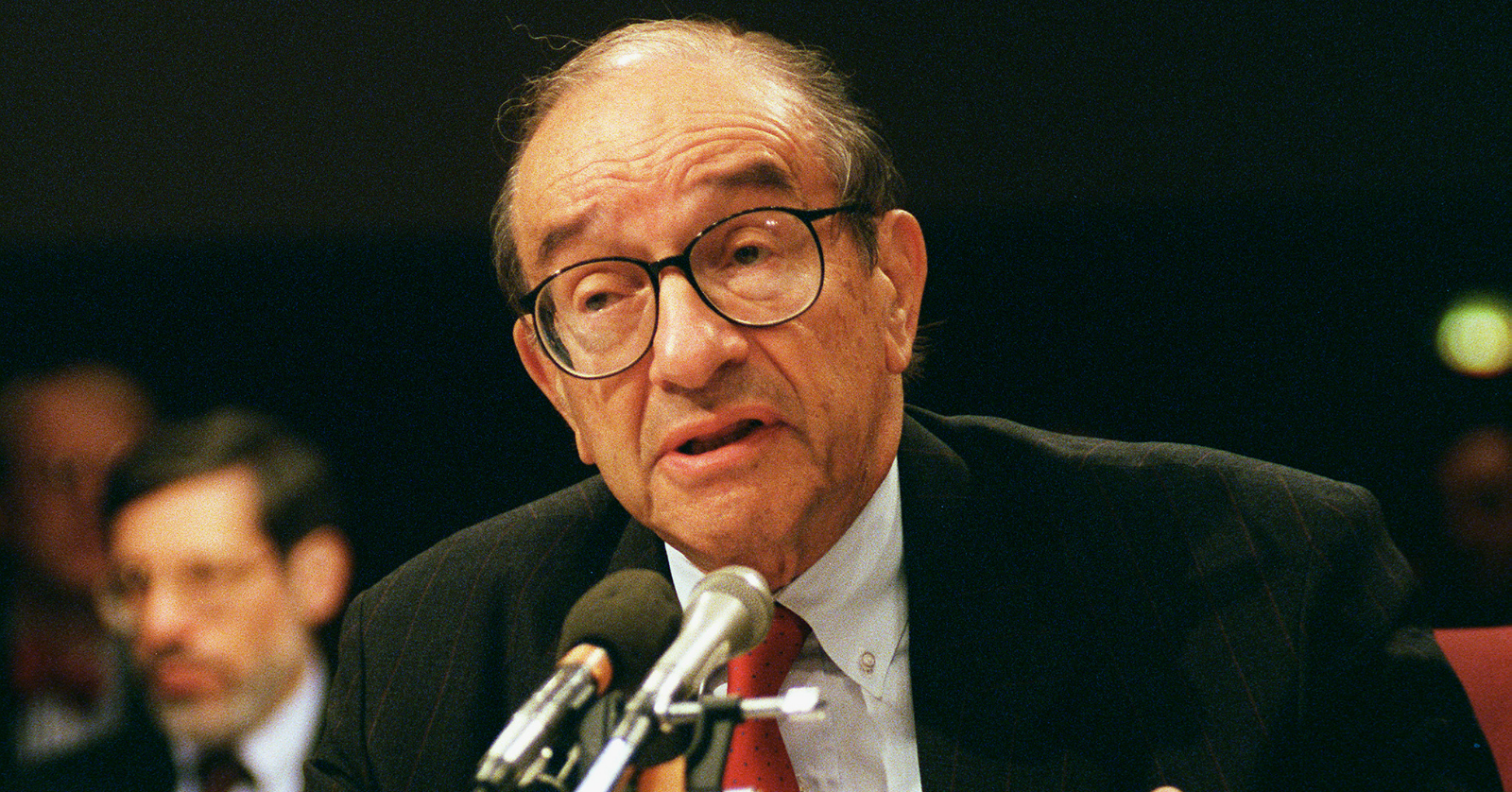
At the age of 100, Alan Greenspan, who was chairman of the Federal Reserve for five terms under four different presidents, died on Monday, June 22.
From 1987 to 2006, Greenspan was the 13th chairman of the Federal Reserve, having been nominated by President Ronald Reagan, and going on to serve under Reagan, President George H.W. Bush, President Bill Clinton, and President George W. Bush.
Greenspan is credited with guiding America’s finances toward a fiscal boom during the Clinton administration, but his policies are also attributed with bringing about the financial crisis of 2008.
He is survived by his wife of 29 years, Andrea Mitchell, who is the NBC News chief in Washington and foreign affairs correspondent.
In a statement to NBC News, Mitchell said:
“Alan passed away at our home this morning at the age of 100 from complications of Parkinson’s disease. He was a giant of a man who helped shape the U.S. economy for decades under presidents of both parties, but was always honest in acknowledging his mistakes.”
Further, Mitchell stated, “To me he was my husband, who shaped my life from our very first date in 1984. He had ‘irrational exuberance’ for baseball, the Washington Commanders, tennis, golf and music, especially jazz.”
Concluding her statement, she wrote, “He will be remembered for his brilliance and his kindness. Being his life partner was the joy of my life.”
During the 1997 White House Correspondents’ Dinner, comedian Norm MacDonald had both Greenspan and Mitchell laughing as he joked about their marriage that year.
Describing Greenspan as “the most powerful man in the country,” MacDonald then quipped about his age, noting Greenspan was 71 at the time, saying, “This is sweet — you know, I didn’t know this — they wrote their own vows. She promised ‘to love, honor, and speak into his good ear.'”
Watch the full joke, including footage of the couple laughing, here:

RELATED: Trump Signs Initial Peace Deal With Iran
The Life And Financial Times Of Alan Greenspan
Born in New York City in 1926, Alan Greenspan would go on to become formed as a fiscal thinker by the likes of Arthur F. Burns, an economist at Columbia University who went on to be the 10th chairman of the Federal Reserve.
He was also a disciple of novelist and philosopher Ayn Rand, whose 1957 novel Atlas Shrugged and her promotion of Laissez-faire capitalism went on to influence many libertarians and conservatives.
Confirmed as the 13th chairman of the Federal Reserve in 1987, he was confronted with addressing the 1987 stock market crash only two months into his tenure.
Pulling the nation out of the crisis and into a period of fiscal strength, even during the Gulf War in 1990-’91, his technique became known as “the Greenspan put,” but has been criticized for promoting excessive risk-taking.
These policies would be adjusted to confront the Dot-com bubble of the late ’90s and early 2000s, but would go on to incite the housing bubble that would burst, bringing about the Great Recession of 2008.
In 2006, after his retirement, Greenspan was honored with the highest civilian honor, the Presidential Medal of Freedom, by President George W. Bush.
Remembered at the time as a “steadfast and effective manager of the United States’ monetary policy,” it was said that his “prudence and wisdom” he “helped shepherd our economy through stock market crashes, global fiscal crises, recessions and natural disasters.”
Watch him receive the Medal of Freedom, here:

When the financial crisis struck in 2007, coming to a fever-pitch in 2008, Greenspan’s ignorance of the housing bubble was highlighted, NBC News noted.
In a 2011 report filed by the Financial Crisis Inquiry Commission, which was established by President Barack Obama in 2009, the bipartisan commission took many to task, including Greenspan, for their hand in the Great Recession.
Concluding that “widespread failures in financial regulation and supervision proved devastating to the stability of the nation’s financial markets,” the report states:
“More than 30 years of deregulation and reliance on self-regulation by financial institutions, championed by former Federal Reserve chairman Alan Greenspan and others, supported by successive administrations and Congresses, and actively pushed by the powerful financial industry at every turn, had stripped away key safeguards, which could have helped avoid catastrophe. This approach had opened up gaps in oversight of critical areas with trillions of dollars at risk, such as the shadow banking system and over-the-counter derivatives markets.”
After his 2006 retirement as chair of the Federal Reserve, he was succeeded by Ben Bernanke.
Other chairs of the Federal Reserve since then include Janey Yellen, Jerome Powell, and Kevin Warsh, the latter of which was confirmed on May 22.
Watch David Letterman’s lively interview with Alan Greenspan in 2007 — in which Letterman humorously asked, “What is it you did?” — here: