Eric Church Encourages Graduates Not To Be Set “Out Of Tune” By The World During Inspiring Commencement Address

on • Updated
The Country Artist Shared A Powerful Musical Analogy With Students At UNC Chapel Hill
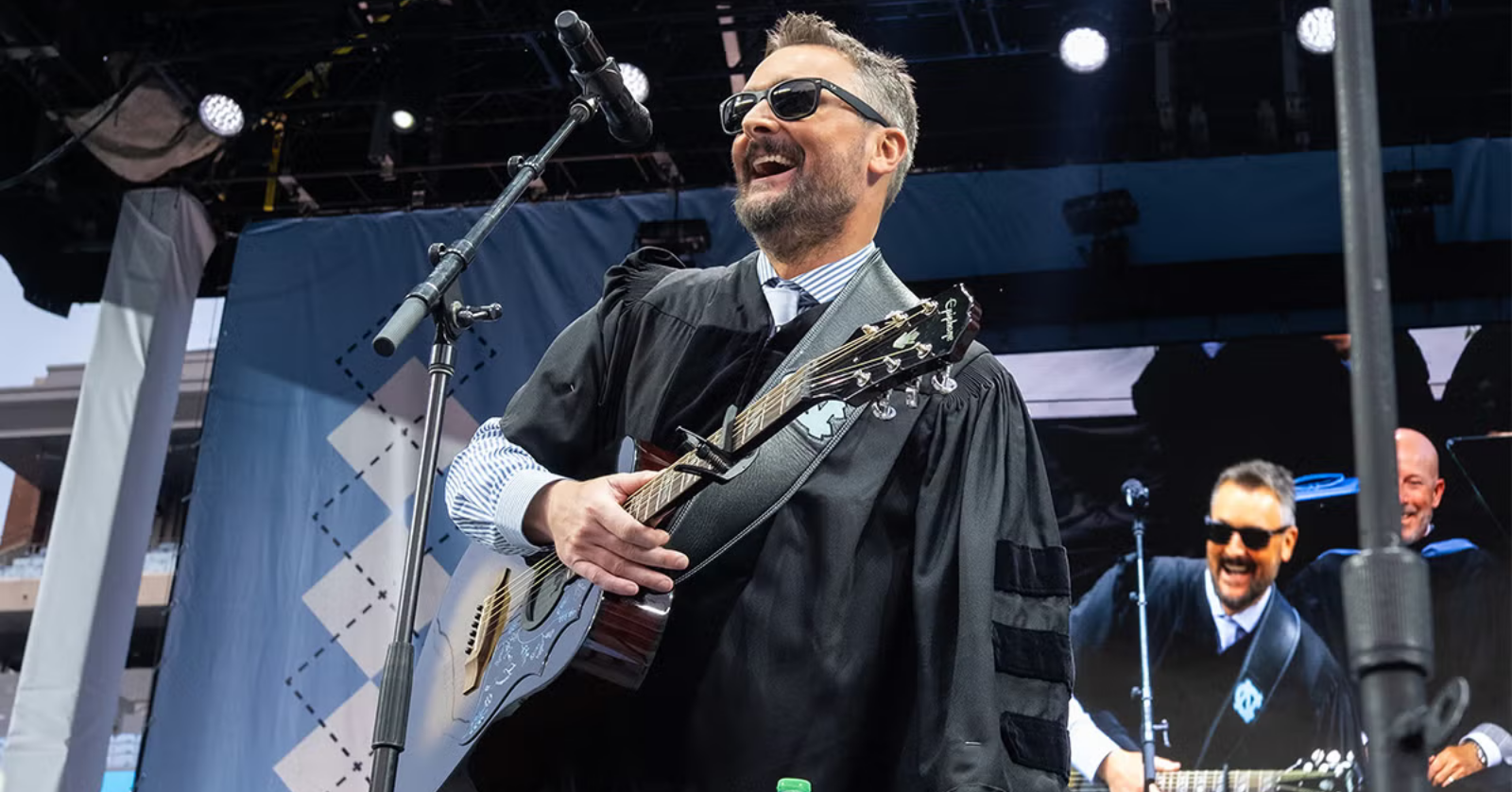
Country artist Eric Church gave the commencement address for the class of 2026 at the University of North Carolina at Chapel Hill, and it was a commencement address unlike any other.
Delivered on May 11, Church, who is a North Carolina native, would’ve been perfectly welcome to speak from the heart, but he started his speech by saying that he was at a loss for how to do this at all.
With a guitar slung on his shoulder, he built his speech around a complex — yet readily understandable — analogy involving music.
“I have torn up multiple speeches, I have thrown things,” Church admitted. “In one of my fits of frustration, I sat down with a guitar, and I thought, ‘Man, who am I kidding? I need to figure out a way to do this with a guitar.”
From there, he then delivered a speech that was, at once, creative and inspiring.
Six Strings, One Life
With his signature dark sunglasses on, Church then said he was going to play a sound, stating, “You know this sound, it’s a guitar that’s out of tune. Something that almost gets there — that tries — but doesn’t, and some ancient, honest part of your brain knows it immediately.”
He added, “You don’t need training to hear it, you just know. That sound is the sound of something beautiful that has not been tended to.”
He then played each string of the guitar, with the last string clashing with the others.
“Six strings,” he said. “When all six are in tune, the chords they make can stop a conversation cold, carry a broken person through the worst night of their life, or make a room full of strangers feel for three minutes like they’ve known each other forever.”
Continuing, he said, “But if even one [string] is off, the whole chord unravels — not gradually, not politely.”
Getting to the crux of his speech, Church then declared, “I believe your life runs on this principle, and I’m gonna break it down for you right now and tell you about your strings, OK?”
String 1: Faith
Focusing on the top string, the low E, he said that string is “your foundation,” noting it is the thickest and heaviest of the guitar strings, “Every chord a guitar can make rests on this string being in tune.”
Expounding on this, he said, “Your faith is the low E of your life … Your belief about what this life is for, what you owe, what holds the universe together when science reaches the edge of its own explanation and shrugs.”
Powerfully, Church then said, “The people who tend to their faith in ordinary seasons do not come undone in extraordinary ones. They still hurt, they still sit in hospital waiting rooms asking unanswerable questions at 3 in the morning, but they have a foundation to return to.”
He then said, “The world will try to untune this string — through busyness, through slow accumulation of a full schedule, through a full inbox, a full life.”
String 2: Family
“Look out at these bleachers, look around,” Church said. “Somewhere in that crowd is someone who has loved you longer than you were easy to love.”
He said this kind of person is someone “who saw you at your actual worse … and didn’t leave you,” adding, “Someone who sat alone in a quiet house and cried the weekend you moved into dorms and wondered, ‘Have I done enough?'”
The A string, Church said, is family, which he said is “where the music starts to get warm.”
He said this string “gives a chord its body, its richness.”
Church then gave the graduates of UNC a warning, saying, “You’re about to get busy in ways that feel important, and many are. Professionally ambitious, creatively alive, building the life pointed toward for four years.”
Family, he said, will “rarely demand your time,” saying that family will say “they understand,” but he urged the students to not take their family up on that. “Call your people, not when there’s news. Not when there’s nothing. Show up when it costs you something, let them see you when things are hard.”
Concluding the second string, he said, “The A string is not a holiday, it’s an every day string — protect it.”
String 3: The Heart
Turning to the D string, Church said this is “the heart of a chord,” as it “gives a chord its body and its soul.”
“The person you choose to share your life with is the most important decision you will ever make, outside of your faith,” he said. “They will either amplify every other string you’re playing, or slowly pull the whole instrument into an out of tune mess.”
To laughter, Church then alluded to his wife, Katherine, quipping, “Not that I know that. I love you, honey.”
He then encouraged the graduates, saying, “Find your best friend. Someone you want to talk to at the end of a long day. Look for shared values over shared interests.”
Getting the UNC crowd enthused, he said it didn’t matter if you liked the same things, but said, “Though it would be a benefit if you both hated NC State.”
Elucidating the power of the D string, he said, “The right partner is the string that makes the whole chord fuller, and warmer, and truer than anything you could ever play alone.”
String 4: Ambition
For the next string, the G string, he got a laugh by virtue of its name, but quickly reeled the audience back in, saying, “The G string drift faster than the others on a guitar, I can promise you that is true. I have dealt with it my whole life.”
The reason for this, he said, is “because ambition and resilience both live on this string, and they pull in opposite directions.”
Continuing, he said, “I want you to want things. You should want things. The world has more than enough people standing at the edge of their own potential waiting for a permission slip that was never going to arrive.”
Encouraging the graduates, he said they should “want the thing,” and they should “say it out loud.”
From there, he reminded everyone that they will see failure at some point in their life, but he turned to the words of Ernest Hemingway, quoting, “The world breaks everyone. Afterward, the best of us are stronger at the broken places.”
Adding onto Hemingway’s sentiment, Church then offered, “Get back up, tune the string, keep playing.”
String 5: Community
“The B string is about community,” Church said. “Your generation faces a temptation no generation has ever faced: the temptation to perform for everyone and belong to no one.”
Defining this temptation, he said it is marked by being “globally visible, and locally invisible,” adding that one could “have thousands of followers, and no one knows actually where you live.”
Simply, Church advised that the UNC graduates should “resist this.”
As an antidote to the temptation, he said:
“Plant yourself somewhere. Put down roots with the full intention of growing there. Learn the actual names, not usernames, of the people around you. Volunteer. Coach the team. Build the thing your community needs even. if the internet will never see it.”
He added, “Generosity is not something you do after you make it, it’s how you make it.”
Church said that UNC is such a place that can ground someone when they lose track of themselves, stating, “Carry this community as you plant your roots. It will repay bountiful harvest, and make your song richer and fuller.”
String 6: Individuality
“Finally, the high E string,” Church said, noting it is the thinnest string, but the one that carries the melody.
Continuing his analogy, Church stated that the E string “is the one that’s bent most easily by outside pressure.”
He said that social media will be presenting UNC graduates with lies, saying, “Someone’s comments, someone’s criticism, someone’s cold opinion is going to try to convince you to retune yourself to match what they think you should sound like.”
Offering advice, he said, “Do not let them touch your string.”
Alluding to Psalm 139:14, Church said, “You are made uniquely, wonderfully, distinctly. There’s a sound only you can make, a voice that has never existed before you and will never exist again — a contribution only you can bring, a way of seeing that belongs to only you.”
He then said, “The world does not need another cover song. It needs an original.”
Speaking broadly, he said that every string will drift, and that it’s a matter of being honest with one’s self.
“Life won’t be right until it is tuned,” Church said. “Trust what your heart hears and is telling you about your song.”
Watch Eric Church’s full commencement address, which he wrapped up with a performance of his 2009 song “Carolina,” here: