War Powers Vote Ignored As Trump Says Iran Ceasefire Is “Over”

on • Updated
For three weeks, the idea of a ceasefire between the United States and Iran was observed, but that peace has proven to be a fragile thing.
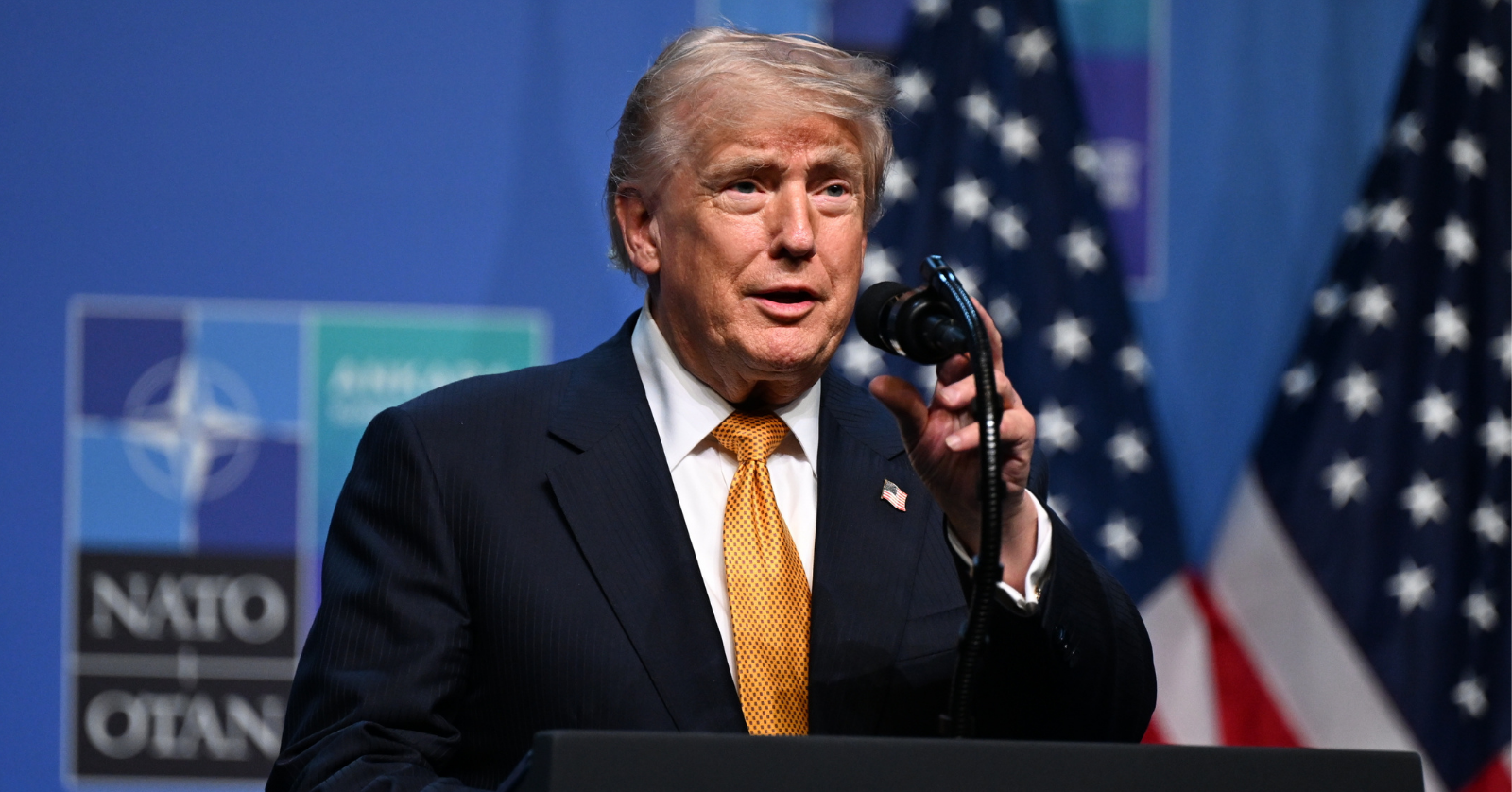
On Wednesday, July 8, President Donald Trump spoke on the status of the peace talks with Iran, telling the public during a news conference at the NATO summit in Turkey that the ceasefire is “over.”
Speaking on Iran’s leadership at another NATO summit news conference on July 8, he added, “They’re dishonorable people, and they can’t keep a deal.”
This is backed up by the United States resuming military strikes against Iran in the evening of July 7 after Iran reportedly attacked cargo ships in the heavily contested waters of the Strait of Hormuz.
Trump went on to warn Iran that there would be more strikes that night, with July 8 seeing extensive military strikes, with at least 90 targets hit.
Video of these strikes was shared online by U.S. Central Command, which can be viewed here:
🚨 JUST IN: The Pentagon releases videos of American forces OBLITERATING over 90 TARGETS in Iran tonight in retaliation for the regime’s attacks on civilian vessels
— Nick Sortor (@nicksortor) July 9, 2026
This is in ADDITION to the 80 targets hit last night by U.S. forces.
Tonight’s strikes included “air defense… pic.twitter.com/DV9xVQbYDd
However, this action defies both the U.S. House of Representatives and the Senate which voted to limit Trump’s war powers.
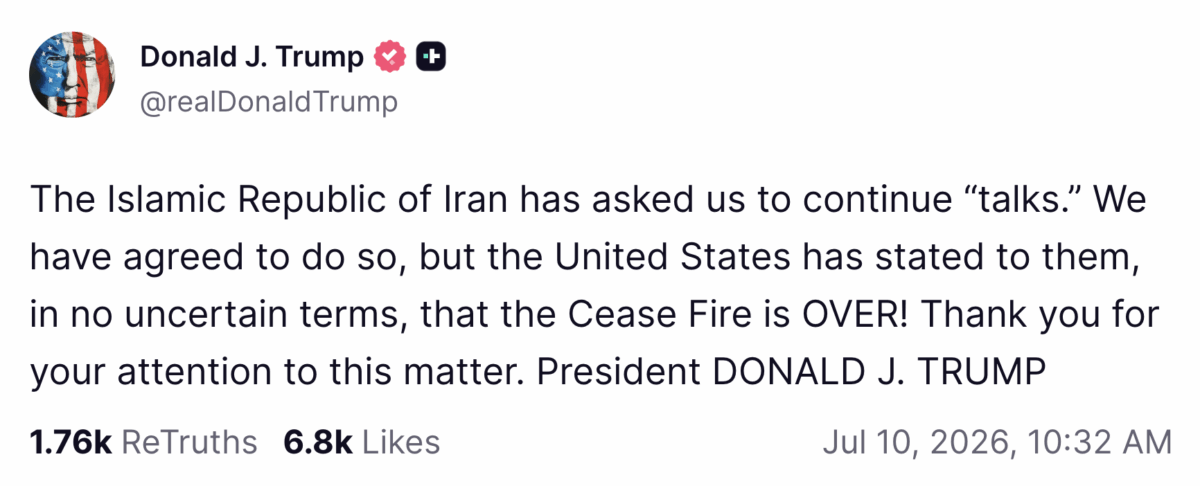
As of July 10, Trump says that “talks” are set to continue between the United States and Iran, with Trump making it abundantly clear that “the Cease Fire is OVER,” writing on Truth Social:
Trump Speaks On Further Strikes Against Iran
Operation Epic Fury began on Feb. 28, with Trump making the goal of the conflict, and its potential cost in the loss of American lives, clear: the denuclearization of Iran.
This was reiterated by Trump during a bilateral meeting with Ukrainian President Volodymyr Zelenskyy at the NATO summit in Turkey on July 8, exactly 21 days since Trump signed a Memorandum of Understanding (MOU) with Iran.
That MOU initiated a 60-day period of negotiations between the United States and the Islamic Republic, with both nations working to iron out an agreement with a 14-point list as its starting point.
Those 14 points, which can be viewed here, include a controversial $300 billion rebuilding effort for Iran, as well as the removal of the U.S. military from the proximity of Iran within 30 days.
All of that progress is in a precarious position, now.
“To me, I think it’s over,” said Trump of the ceasefire on July 8, following a night of retaliatory military strikes against Iran.
Watch Trump speak on the ceasefire with Iran being over, here:
.@POTUS on the status of the ceasefire with Iran: "To me, I think it's over. I don't want to deal with them anymore. They're scum… They're led by sick people… I'll speak to our negotiators. They want to negotiate—they're good people… but they have to come back to me. As far… pic.twitter.com/6eYfwMxSdn
— Rapid Response 47 (@RapidResponse47) July 8, 2026
On Tuesday, July 7, U.S. Central Command confirmed that it had begun a series of strikes against Iran, writing on X, formerly Twitter, “The U.S. strikes are in response to Iranian attacks on three commercial vessels that were transiting the Strait of Hormuz. Iran’s demonstrated aggression was unwarranted, dangerous, and a clear violation of the ceasefire.”
Trump then posted a video of the strike on Truth Social.
Speaking on the Iranian sites targeted in the latest wave of strikes, Sec. of War Pete Hegseth said, as quoted by NBC News, that “a big part of what we targeted … [included] underground facilities where they were storing drones or missiles, coastal defense sites, radar sites, surveillance sites, anything used to harass shipping in the Strait of Hormuz.”
Some military footage of the strikes was released, with U.S. Central Command noting there were about 80 targets, 60 of which were small boats utilized by the Iran’s Islamic Revolutionary Guard Corps.
See the July 7 strikes on Iranian targets, here:
🚨 JUST IN: The Pentagon confirms the US military struck OVER 80 targets in Iran via precision strikes tonight after the regime attacked multiple civilian vessels in the Strait
— Nick Sortor (@nicksortor) July 8, 2026
They’ve released the attached video of the strikes
“U.S. forces struck Iranian air defense systems,… pic.twitter.com/CO9yMhN4bn
While in the July 8 bilateral NATO summit meeting with Zelenskyy, Trump said, “We’ll probably hit them hard again tonight. I’ll give a little warning: we’re gonna hit them hard tonight.”
Hegseth went on to add, “Tonight, if we need to, on your order, Mr. President, we will hit even more, even deeper, because that’s the concept.”
During Trump’s final NATO summit news conference on July 8, he responded to a question about why he wasn’t going to be flying from Turkey on Air Force One, noting that Trump had mentioned the threat of an Iranian assassination attempt a few times over the past couple days.
Trump stated that Air Force One was stopping at a military base in England to allow U.S. troops to tour the new plane from Qatar, but admitted, “I’m No. 1 on the kill list for Iran.”
See the moment Trump addressed the possibility of an Iranian assassination attempt on his life, here:
🚨 Alert.
— Autist The 17th (@AutistDivision) July 8, 2026
Threat of assasination on Trump.
Trump received, by his own words, 2 lists from the Intel Agencies, and he's No 1 on those "kill" lists. The threat comes from Iran.
He also said he won't be traveling back home in AF1. Air Force One will stay in Europe, and it's gonna… pic.twitter.com/mEA3WPwfVB
Trump will, instead, be flying on an older Air Force One, Reuters reports.
Watch Trump speak during his bilateral meeting with Zelenskyy on the situation with Iran, warning that another military strike is due in the evening of July 8, here:

RELATED: Trump Signs Initial Peace Deal With Iran
Congress Voted To Limit Trump’s War Powers
On June 23, the U.S. Senate voted 50-48 to limit Trump’s war powers, invoking the War Powers Resolution Act, following the U.S. House of Representatives vote of 215-208 earlier in June.
This concurrent resolution was approved in a bipartisan rebuke of Trump’s action in Iran, particularly after the fallout from the release of the 14-point terms of negotiation between the U.S. and Iran.
Three Republicans — Sen. Susan Collins, R-ME; Sen. Lisa Murkowski, R-AK; and Sen. Bill Cassidy, R-LA — voted with the majority of Democrats to pass the war powers limitation, with Sen. John Fetterman, D-PA, joining the Republican majority in voting against the measure.
Sen. Rand Paul, R-KY, changed his vote from supporting the war powers limitation to simply voting “present.”
A concurrent resolution, like the war powers limitation, does not require the signature of the president.
Speaking with CNN, a White House official, who spoke anonymously, said, “Concurrent resolutions do not go to the president and have no force of law.”
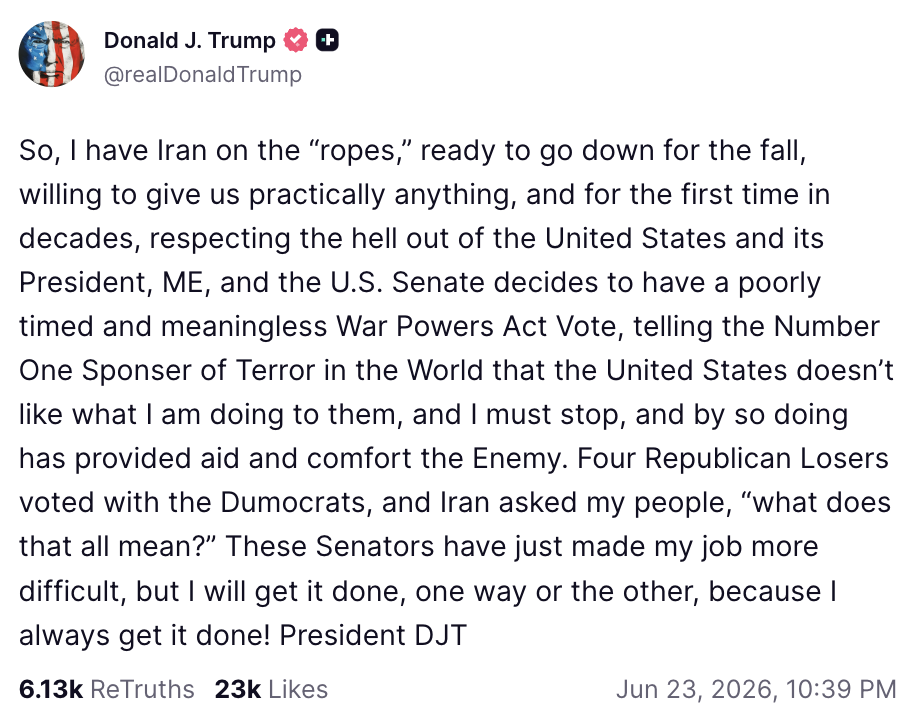
Trump responded to the June 23 vote, writing on Truth Social, “These Senators have just made my job more difficult, but I will get it done, one way or the other, because I always get it done!”
See his full post, here:
Responding to the July 7 strikes and Trump saying the ceasefire is “over,” several Democrat lawmakers have responded, saying they will push to enforce the War Powers Resolution.
This is a developing story.
RELATED: Enrollment Is Open For Trump Accounts, And Some Kids Get $1,000 On Day One