Why Daylight Savings Time May Soon Be Permanent

on • Updated
Twice every year, Americans change the time on their clocks, springing forward in the spring for Daylight Savings Time, and falling back in the fall for Standard Time.
On Tuesday, Aug. 4, President Donald Trump renewed his push for ending the practice of changing the clocks, voicing his support for a permanent Daylight Savings Time by saying, “In other words, leave it as it is now, and never change again.”
Back on July 14, the United States House of Representatives voted 308-117 to approve allowing for an end to the practice of switching from Standard to Daylight Savings Time.
While the bill now awaits the Senate’s approval, The Sunshine Protection Act will permanently make Daylight Savings Time the nation’s new Standard Time, but it leaves room for each state to decide what is right for them.
Sponsored by Sen. Rick Scott, R-FL, he stated on X, formerly Twitter, “Let’s leave the decision up to the states so we don’t have to change our clocks twice a year.”
Watch Sen. Scott speak on the bill, here:
I get asked about my Sunshine Protection Act all the time. It’s simple:
— Rick Scott (@SenRickScott) July 15, 2026
Let’s leave the decision up to the states so we don’t have to change our clocks twice a year.
I’m thrilled that the house has finally passed it. The Senate needs to take it up NOW and send it to President… pic.twitter.com/OdbtGOcJiK
Responding to the House’s vote, Trump simply wrote on Truth Social in the morning of July 15, “Great News for America!”
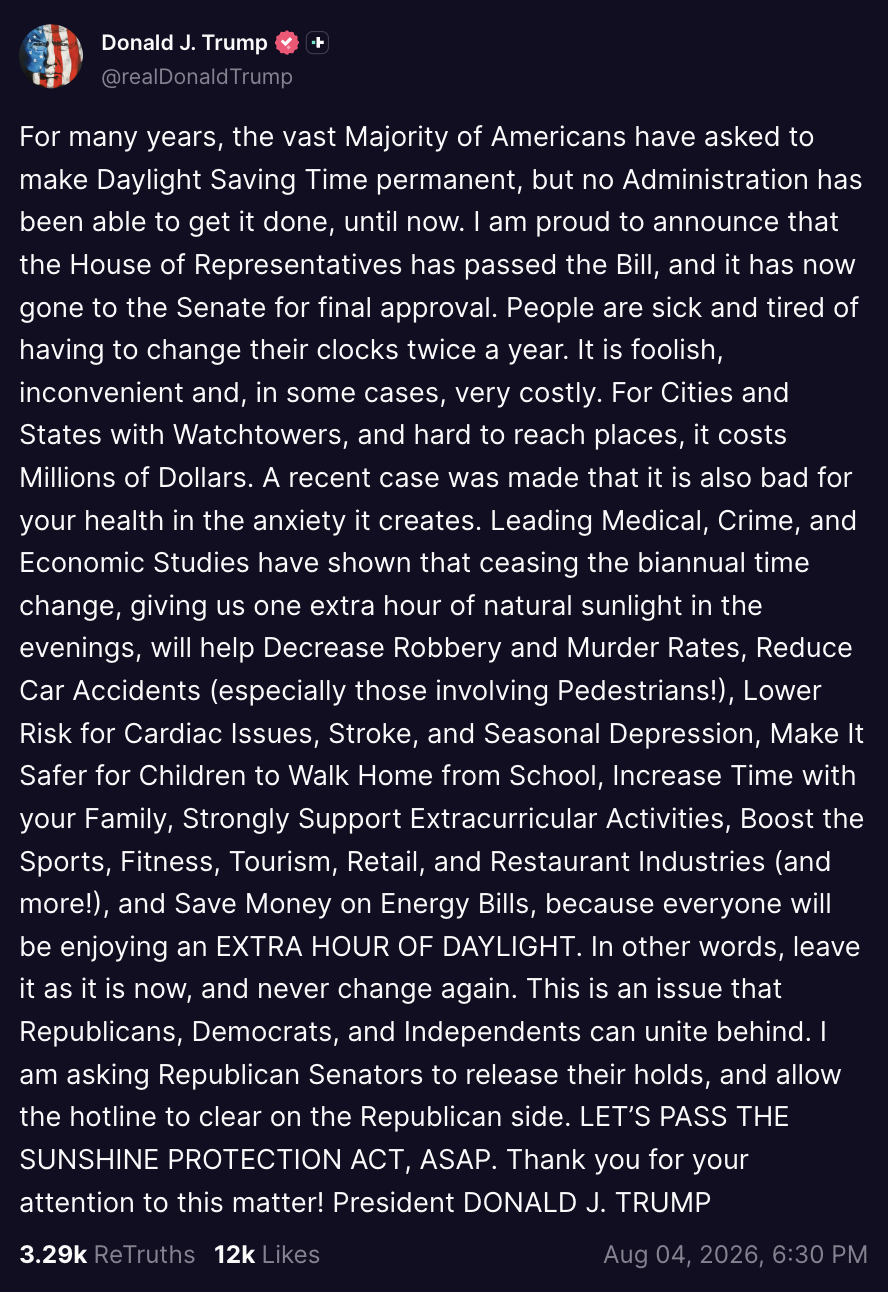
In his lengthy Aug. 4 statement of support for the bill, Trump wrote:
“People are sick and tired of having to change their clocks twice a year. It is foolish, inconvenient and, in some cases, very costly. For Cities and States with Watchtowers, and hard to reach places, it costs Millions of Dollars.”
The issue of switching to and from Daylight Savings Time and Standard Time is a simple one, but it is a subject that inspires strong opinions among many legislators. Doing away with the practice is also something that the United States has attempted before, but was swiftly brought to an end.
RELATED: Enrollment Is Open For Trump Accounts, And Some Kids Get $1,000 On Day One
Trump’s Varying Stances On Daylight Savings Time Over The Years
If Standard Time were to be made the norm, there would be more morning light. Conversely, if Daylight Savings Time was preserved and extended year-round, there would be more light in the afternoon.
Across Trump’s two terms as president, he has expressed varying perspectives on which time he prefers.
Ultimately, what’s clear is that Trump is opposed to changing the time in general, preferring a consistent year-round time.
On May 21, Trump posted to Truth Social defending The Sunshine Protection Act, which seeks to maintain Daylight Savings Time for the entire year.
He wrote:
“It’s time that people can stop worrying about the ‘Clock,’ not to mention all of the work and money that is spent on this ridiculous, twice yearly production. It will also be a very nice WIN for the Republican Party. Take it! We are going with the far more popular alternative, Saving Daylight, which gives you a longer, brighter Day — And who can be against that — This is an easy one!”
During Trump’s first presidential term, Trump also put his support behind making Daylight Savings Time permanent, writing on X, then Twitter, in 2019:
Making Daylight Saving Time permanent is O.K. with me!
— Donald J. Trump (@realDonaldTrump) March 11, 2019
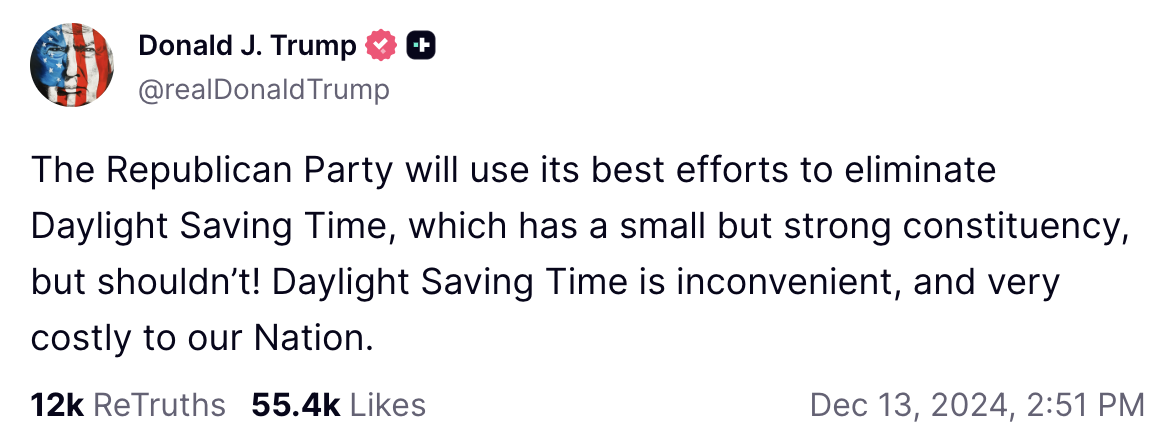
As president-elect in December of 2024, Trump posted a somewhat controversial statement on Truth Social… controversial, as he seemed to be backing a permanent Standard Time instead.
“Daylight Saving Time is inconvenient, and very costly to out Nation,” wrote Trump.
See his full post from December 13, 2024, here:
In March of 2025, Trump addressed the issue from the Oval Office while taking questions from the press. There, he said it “should be the easiest issue of all,” but admitted it was a “50/50 issue.”
Watch Trump speak on the time change in March of 2025, here:
Trump on Daylight Savings: "It's a 50/50 issue and if something is a 50/50 issue, it's hard to get excited about it. I assume people would like to have more light later, but some people want to have more light earlier because they don't want to take their kids to school in the… pic.twitter.com/PKmF6kqLI0
— Bruce Snyder (@realBruceSnyder) March 6, 2025
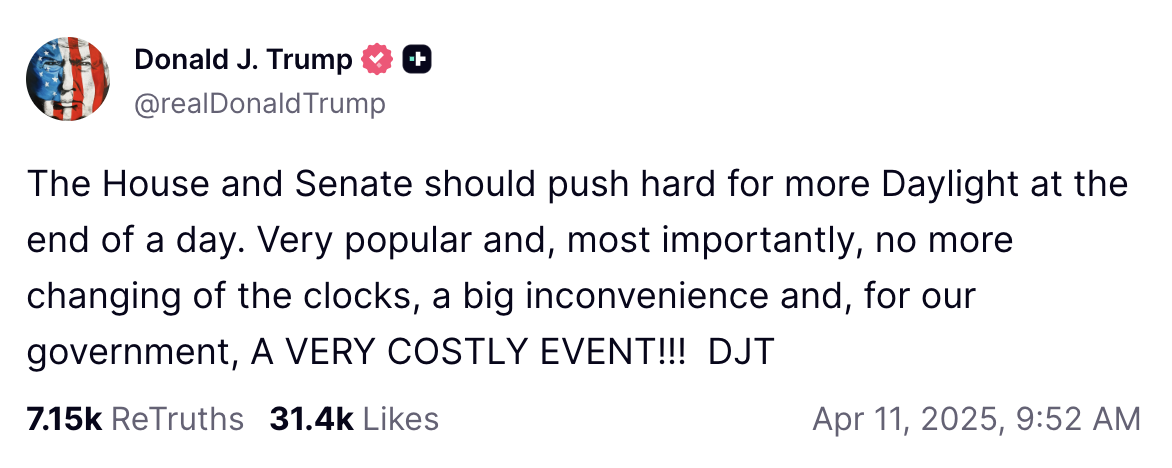
Then, in April of 2025, Trump made his stance more clear, writing on Truth Social:
Since then, his stance has remained consistent with the passing of The Sunshine Protect Act, affirming the preservation of Daylight Savings Time.
His Aug. 4 statement on Truth Social is his latest push for the bill to become law, urging the Senate to unite on the subject, writing, “This is an issue that Republicans, Democrats, and Independents can unite behind.”
See his full post, here:
RELATED: Trump Gives Chilling Message To Iran About What Will Happen Next If He’s Assassinated
The Sunshine Protection Act Heads To The Senate
Standard Time and Daylight Savings Time was enacted by Congress in 1918 in the Standard Time Act.
This act also formally instituted the time zones of the continental United States.
As such, an act of Congress would be needed to do away with Standard Time.
Prior to Trump’s second term, there was a bipartisan push for more sunshine in the afternoon.
Led at the time by then Sen. Marco Rubio, R-FL, with many supporters from both sides of the aisle signing on as sponsors, The Sunshine Protection Act has gradually been gaining traction.
The bill seeks to make Daylight Savings Time the rule of the land.
Among its sponsors is Sen. Ed Markey, D-MA, who said of the Act in 2024:
“This head-spinning ritual of falling back and springing forward has gone on long enough. It isn’t just a nuisance — changing our clocks also has a very real impact on our economy, our health, and our happiness. More sun means more fun, so let’s pass the Sunshine Protection Act, which would make for brighter days year-round.”
Rubio was also quoted, saying, “It’s time to lock the clock and stop enduring the ridiculous and antiquated practice of switching our clocks back and forth.”
He added, “Let’s finally pass my Sunshine Protection Act and end the need to ‘fall back’ and ‘spring forward’ for good.”
The Sunshine Protection Act passed the Senate unanimously by a voice vote in 2022, but was denied by the House of Representatives.
In early 2025, the Sunshine Protection Act was again brought forth, but this time by Sen. Rick Scott, R-FL, as Rubio is now Secretary of State.
There are some states with legislators who have expressed concern about a permanent Daylight Savings Time meaning darker days overall, such as in Indiana, but the latest iteration of the bill allows for states to choose to change the time if they desire to do so.
With the House now approving the bill on July 14, it now heads to the Senate, but its future remains uncertain.
Politico reports that some Republican senators are opposed to The Sunshine Protect Act, namely Sen. Tom Cotton, R-AR, adding that even Senate Majority Leader John Thune, R-SD, has opposed the bill as recently as 2025.
Quoting Sen. Cotton, The New York Times notes that he said of the 2025 iteration of the bill, “By moving the clock back an hour in winter, permanent daylight-saving time would push winter sunrises to an absurdly late hour, depriving Americans of morning sunshine that’s essential for our safety and well-being.”
RELATED: Tulsi Gabbard Declassifies Files Exposing COVID Cover-Up As Her Final Act As DNI
Permanent Daylight Savings Time Has Been Tried In The U.S. Before
Briefly, from January 6, 1974, to October 27, 1974, a Congressionally-approved trial period of a permanent Daylight Savings Time was enacted. This was signed into law by President Richard Nixon in December of 1973.
The Emergency Daylight Saving Time Energy Conservation Act of 1973 was short-lived.
While the push for the permanent Daylight Savings Time was made amid an energy shortage, the enacted policy quickly lost public support and interest.
As morning commute fatalities increased in Northern states which experienced darker mornings due to the change, the Watergate Scandal threw additional bad publicity on the endeavor.
Nixon announced his resignation from office as the 37th president on August 8, 1974, and his successor, President Gerald Ford, did away with the permanent Daylight Savings Time ahead of schedule by several months in October.
The trial run of a permanent Daylight Savings Time was supposed to go through the end of February 1975.
RELATED: Trump’s July 4 “Salute To America” Undeterred By The Rain