Trump Wins On Trans Sports, Loses On Birthright Citizenship In Supreme Court Decisions

on • Updated
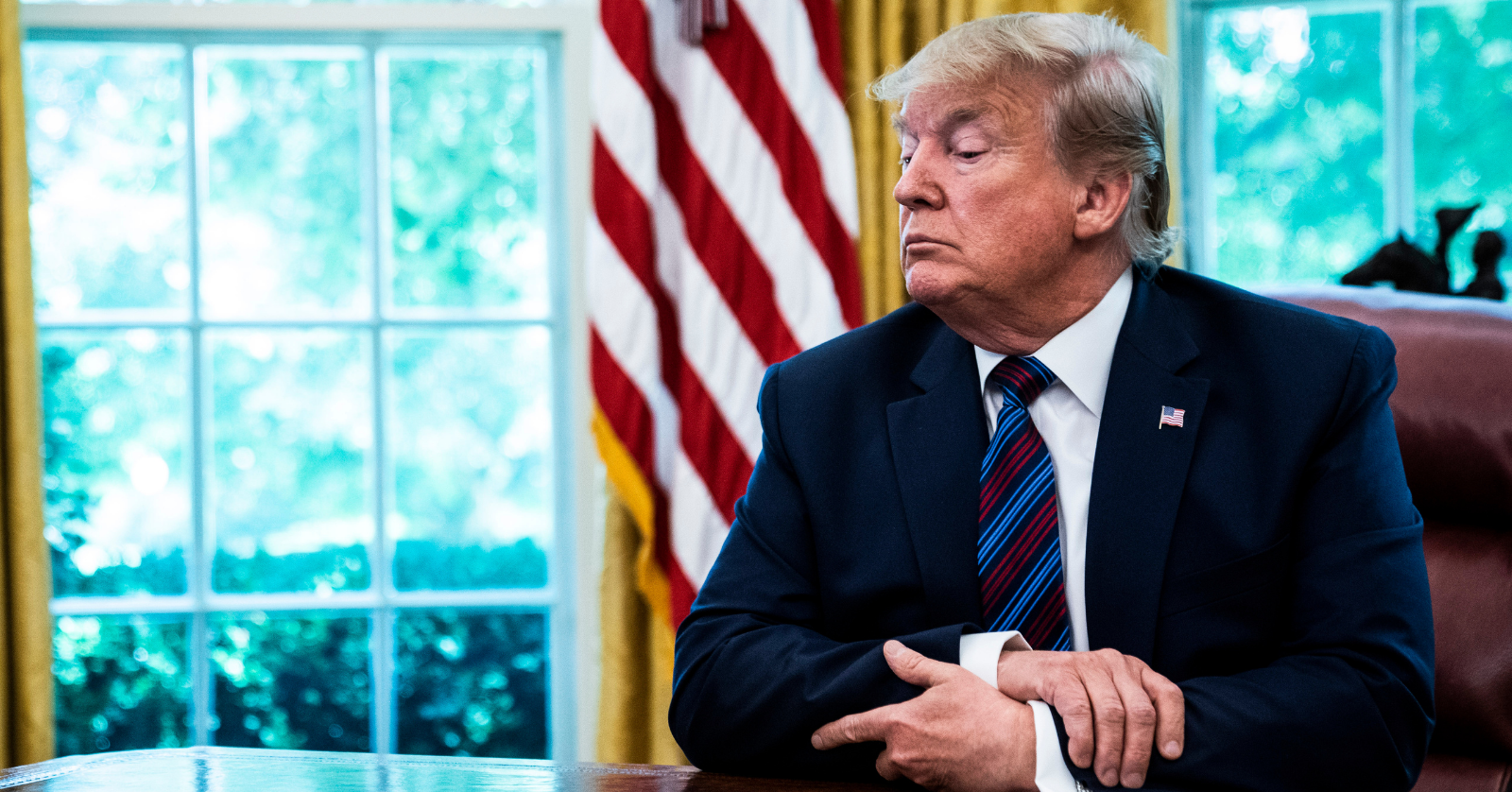
On the final day of Pride Month, observed by the LGBTQIA+ community in the month of June, the United States Supreme Court delivered several decisions — one of which happens to uphold two states’ bans of transgender athletes competing in women’s sports.
In a 6-3 decision, delivered on Tuesday, June 30, states are now allowed to determine eligibility to compete in sports on biological sex.
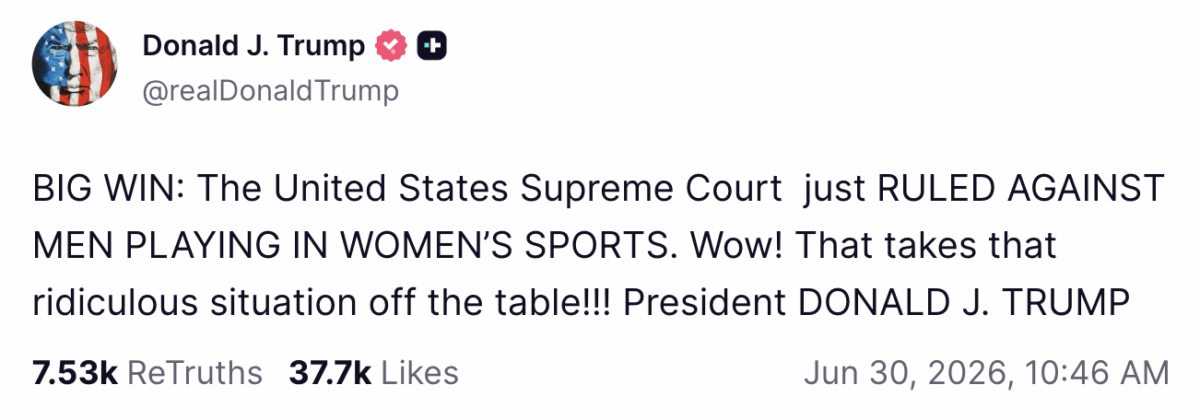
Responding to the court’s opinion, President Donald Trump described it as a “BIG WIN,” writing on Truth Social:
However, not every decision made on June 30 went Trump’s way.
One of his biggest losses involved birthright citizenship, with the Supreme Court being ideologically divided in its 6-3 opinion.
In which by upholding birthright citizenship, as detailed in the 14th Amendment, children born on American soil, even those who are from illegal migrants or foreign workers with visas, are citizens.
RELATED: Tennessee Replaces “Pride” With “Nuclear Family Month”
The Court Rules To Protect Women’s Sports
On June 30, the Supreme Court ruled in favor of the states of West Virginia and Idaho, upholding their right to restrict participation in athletics based on biological sex.
The decision, made in a 6-3, found the Supreme Court divided on ideological lines, with the three dissenting votes coming from Justices Sonia Sotomayor, Elena Kagan, and Ketanji Brown Jackson.
This opinion has the potential of opening the door for similar practices in about 25 other states, for a total of 27 states prepared to defend the integrity of women’s sports.
The decision comes just a few months after the International Olympic Committee voted in March to limit eligibility to compete in women’s category sporting events “to biological females, determined on the basis of a one‑time SRY gene screening.”
Riley Gaines, an athlete who has become an advocate for transgender athletes being barred from women’s sports, shared her perspective on the ruling, writing on X, formerly Twitter:
The Supreme Court rules that it's not unconstitutional for states to have sport categories exclusively for women.
— Riley Gaines (@Riley_Gaines_) June 30, 2026
This ruling doesn't mean they MUST have women's sports, just that it's not illegal if they do.
Nonetheless, it's a victory! pic.twitter.com/jM0Ri5WLit
Read the full decision on West Virginia v. B.P.J., regarding transgender athletes, here.
RELATED: Trump Unveils Sweeping Plan To Boost American Families While Empowering Moms
Birthright Citizenship Upheld In Loss For Trump
One of the key policies of Trump’s second term has been his immigration enforcement, which has included a push against birthright citizenship.
During his first successful run for president in 2016, he frequently spoke of “anchor babies,” or children who of illegal migrants who are born in the United States to maintain residency — and even gain legal status — for the undocumented parents.
In an executive order titled Protecting The Meaning And Value Of American Citizenship, which was signed by Trump on the first day of his second term, Jan. 20, 2025, the 14th Amendment was quoted, reading, “All persons born or naturalized in the United States, and subject to the jurisdiction thereof, are citizens of the United States and of the State wherein they reside.”
The Trump administration goes on to say:
“But the Fourteenth Amendment has never been interpreted to extend citizenship universally to everyone born within the United States. The Fourteenth Amendment has always excluded from birthright citizenship persons who were born in the United States but not “subject to the jurisdiction thereof.”
With the Supreme Court’s ruling on June 30, the Trump administration’s interpretation of the Constitution is on hold.
The Supreme Court voted 6-3 on this as well, but was divided ideologically, with Chief Justice John Roberts authoring the majority opinion, which was supported by Justices Amy Coney Barrett and Brett Kavanaugh, as well as Sotomayor, Kagan, and Jackson.
According to the Pew Research Center, “In 2023, mothers who were unauthorized immigrants or had legal temporary status in the U.S. had 320,000 babies, representing about 9% of all 3.6 million babies born in the U.S. that year.”
Of those, the Pew Research Center states that approximately 260,000 of those children would not have qualified for birthright citizenship under the parameters of Trump’s executive order.
Now, a birth certificate is the prevailing proof of citizenship.
See Trump’s response on Truth Social, which includes his hope for legislation which could go around the Supreme Court’s ruling, here:
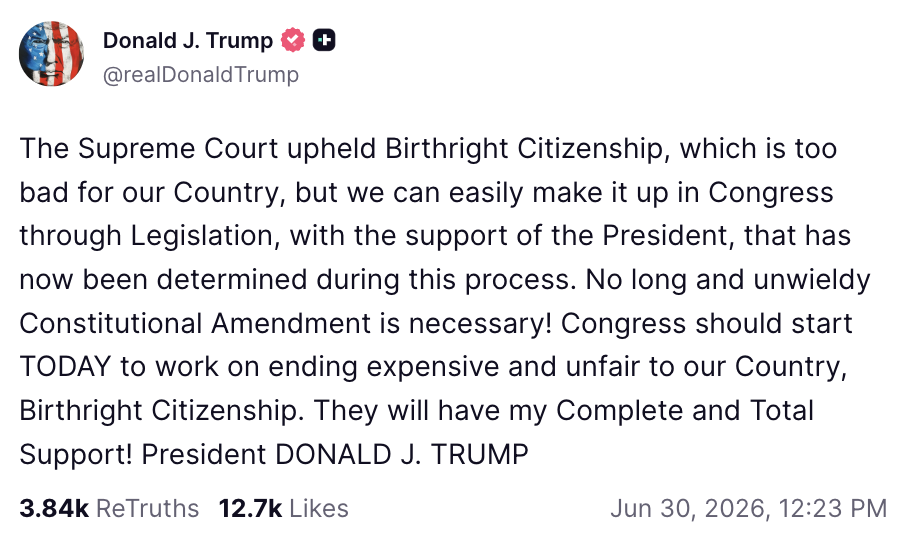
Read the full decision in Trump v. Barbara, regarding birthright citizenship, here.
Still, Trump is lauding the court for its decision in Trump v. Slaughter, released on June 29.
The 6-3 ruling allows for the president to fire officials from independent agencies.
Another victory celebrated by Trump is a lifting of restriction on campaign donations, which is seen as a benefit to Republicans going into the midterm elections.
RELATED: Trump Holds “America Is Back” Rally, Kicking Off Great American State Fair